The PRO League is the first interclub competition with a structured international regular season. Forty-nine clubs, real standings, personalized stats for each player all season. And all of it building to Orlando in January, the largest roundnet event in North America. If you play roundnet, this is the one you want to be in.


A squad-based regular season, three matchdays, 14 to 16 different opponents, every result on the record.
Local clubs inside regional conferences, the English soccer model, built for roundnet. Clubs rise and fall on results.
Squads of seven play under player commitment contracts, your club, your season, your stats.



The league’s short films, shot across the season and Championship Weekend.
Video by Reveal Studios and Spikeball
Video by Reveal Studios and Spikeball
Video by Reveal Studios and Spikeball
Video by Reveal Studios and Spikeball
Video by Reveal Studios and Spikeball
Video by Reveal Studios and Spikeball
Video by Reveal Studios and Spikeball
Video by Reveal Studios and Spikeball
Video by Reveal Studios and Spikeball
Every club in the PRO Roundnet League, coast to coast, across eight conferences.











Four divisions, one ladder. Top finishers promote and bottom finishers relegate every season. Nobody’s place is safe.

The top tier in the Pro League. To make it is one thing. To win it is everything. Even here, the survival bracket still has a podium worth fighting for. But one wrong slip-up and your club is a P2 club.
East and West, one fight: climb out of P2 and into the top ranks of P1. But it cuts both ways. One slip-up and you’re relegated to Minor.
Conference Squads: a team for every woman, at her level.
As the league grows, the Women’s Pro division grows with it, more squads and a bigger stage.
Minor is a club’s shot at a second pro team. The top five M1 squads advance to P2, and the more teams you field, the better your chances. Bring as many players as you can. There’s a place for everyone.
Squads are seven to eight players. Every club fields at least one squad. Most field several, across divisions.
Players sign with one club for the season. The contract is what turns a pickup roster into a team, and it comes with real benefits.

Your squad is seven to eight players who show up for each other across three matchdays, the same group, building chemistry from June to the Playoffs in January.
If you can measure it, you can improve it. League play is tracked across the categories that decide nets.
What a career has proven: the league’s career rating, one number from 1 to 10 that never resets, with every player on the same ladder.
How a player is playing right now, over a match, an event, or the season. Every match starts at 50, league average, and the number climbs toward 99 or falls toward 1 from there.

 Dallas Lonestar · P1 · Texas Conference

 Minneapolis Motion · P1 · North Central Conference
 Dallas Lonestar · P1 · Texas Conference

 Rochester Red Hots · P1 · Northeast Conference

 Atlanta Puffins · P1 · Southeast Conference
The full story: PER and PRO Score, explained with examples in the FAQ.
Every player in the league carries two numbers. One grades your season, the other grades your career, and every net you play feeds both.
*PER: Player Efficiency Rating
1 to 99 · 50 is the average
Your season. How you are playing this year, graded against the field across the net from you. Win your nets, score, and do it against strong pairs, and the number climbs.
1 to 10 · one ladder for the whole league
Your career. One number built from every counted net you have ever played in the league, on the same ladder as every other player. It never resets, and it moves like a résumé: slowly, and only on proof.
Both numbers reward the same things: winning, scoring, and doing it against strong players. A win over a strong pair counts for far more than the same win over a weak one, and both numbers need games behind them before they move much. A hot weekend on a handful of nets is a start, not a statement.
Volume moves both numbers. The more nets behind you, the more your numbers say about your game, and the further a great day can carry them.
Quality games count for more. The stronger the pair across the net, the more a win is worth, and the higher your numbers can climb.
The leaderboards are for players who show up, and the playoffs pack the strongest fields of the year into one weekend, the densest strong-field nets of the season.
Your player profile shows the games that helped and hurt your numbers the most. Want the full picture? How the numbers work
*You have to play two match days in a season to be on the leaderboard. The count runs over the league’s last three events, so last year’s playoffs plus one matchday this season counts. One matchday on its own does not.
League co-founder Alex Hart explains the league’s story, its origins, and its purpose.
Video by Reveal Studios and Spikeball
Every result counts twice, group points move your standings, and every match feeds your Power Score. Both decide who reaches the Championship and Promotion Brackets in Orlando.

Clubs from across the league gathered in Las Vegas and Richmond. P1, P2, M1 and Women’s all played. Matchday 1 details →
Competition goes local. Every club plays inside its geographic conference for standings, Power Score movement and championship qualification. All club members, all divisions, beginners to pro. Matchday 2 details →
The final regular-season matchday, and Day 1 of championship weekend at North East Regional Park, Orlando (turf), 8 AM – 5 PM. Last chance to climb your group before brackets are set.
Standings lock at 3 PM, Slot Choice at 5:30 PM, and Round of 16 bracket play starts at 6:30 PM Friday. Saturday runs from 8 AM until champions are crowned. Playoffs details →
Video by Reveal Studios and Spikeball
One matchday remains, then every road leads to Orlando.
The five Georgia clubs play their Matchday 2 finale, the last regular-season matches before Orlando. Matchday 2 details →
The season finale in the morning, then the Fifth Anniversary Playoffs, with champions crowned Saturday. Playoffs details →
This is where the whole season comes down to two days. Friday, January 29, the regular season finishes with Matchday 3, then Slot Choice, then the first brackets under the lights. Saturday, January 30, every division plays down to a champion at North East Regional Park in Orlando. Nobody goes home early, either: every place plays out, so every club is still playing for something until the last final is done.
Media Contest: upload your plays, win a free Playoffs registration, drawing Nov 30.
Enter the ContestThe league is run by the people who built it. Leadership · Passion · Structure.



Is your club in the league? New clubs join through two steps, a conversation first, then the official application.

Pick the conversation that fits: Call with Alex (15 min), Owner Call (30 min), New Club Exploration Meeting (45 min), or a Sponsor Exploration Call (30 min).
After the meeting, put your club in the league. Every club is reviewed, territory, roster, and a home for your players at every level.



Start here, the season at a glance. Every other answer lives in the full FAQ.
The PRO Roundnet League is a national club-based roundnet league featuring P1, P2, M1, M2, and Women's divisions. Clubs compete throughout the season for standings, playoff qualification, promotion, relegation, and championships. The league is built to create long-term club identity, structured competition, regional growth, and advancement pathways from beginner levels to the highest level of play. The season includes three official matchdays followed by championship playoffs in Orlando, Florida.
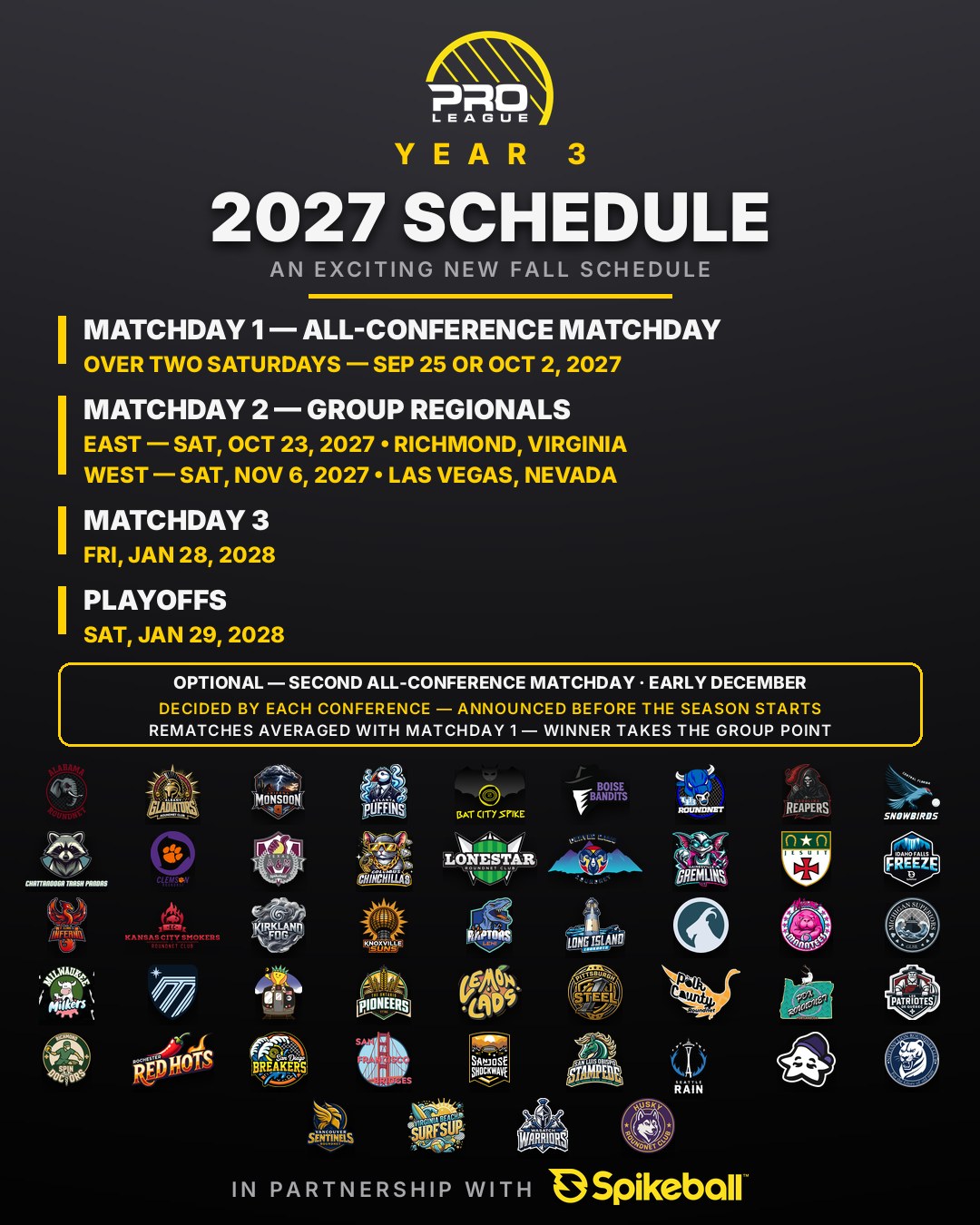
The season includes three primary matchdays:
League standings use a group point system:
Seeding runs off the Power Score, which weighs a squad’s group points per match together with the strength of its results, beating strong squads counts for more than running up wins over weak ones. The Power Score sets the seeding and the Slot Choice order for the Championship and Promotion Brackets, and helps decide their final spots from the Play-In Schedule. The first Power Scores publish November 9.
Your PRO Score is a career rating from 1 to 10 that follows you from event to event. It's built from every counted net you've played in the league, and it looks at your game from several angles:
One guardrail keeps it honest. A small number of nets can't inflate a score: until you've built a real body of work, your score is pulled toward the middle of the pack. Past that, there is no ceiling and no shortcut: the top of the ladder sits wherever the best careers in the league take it, and the biggest wins of a career, the games your profile keeps as your career-defining games, are the ones that move it most.
One number, your whole career, that's the PRO Score. Read it as a résumé, not a prediction: it records what your career has proven, and it grows season over season. Its single-match cousin is PER, which grades one match at a time using the same ideas.
PER, Player Efficiency Rating, is your form this season: one grade for the whole season, on a scale of 1 to 99 where 50 is the average for your competition, the field you actually play against. A 60 in Minor and a 60 in P1 are both strong seasons, graded against different fields.
Every match starts at 50, league average. Finish above 50 and the day went well: you won your nets, and how much you won by, how many points you scored, and how strong the pair across the net was all push the number up toward 99. Finish below 50 and the day went the other way, with the same factors pulling you down toward 1.
Four things grade every match:
One matchday gets its own number: your Matchday Grade is the same grading applied to a single matchday, with nothing blended in, so a great day shows in full. Your season PER blends every matchday together, and it treats a small sample honestly: a PER built on very few nets is pulled toward the average until the body of work behind it is real. Partners share the grade, too: every net grades the pair, so your number reflects the partners you played those nets with.
PER is computed fresh for every match, then rolls up into a Matchday Grade for the day and a PER for the season, so a great month shows up right away. Only official match nets that were fully recorded count: pickup games, partial records, and forfeits never move it.
Because the two numbers do different jobs. A Matchday Grade grades one day on its own: play great that day and the grade says so, in full. Your season PER blends every matchday together, and it pulls a small sample toward the average, so a season built on a modest number of nets lands closer to 50 than the days that made it.
Say your Matchday Grades are 72 and 84, on a light schedule: the blend can print as a season PER in the 60s, below both days. Nothing was taken away; the season number is simply asking for more proof, and stacking more nets at that level pulls the PER up toward the days that built it.
The same blending is why one huge day on a handful of nets does not print at face value: a grade of 80 over 4 nets can land as a PER in the 50s, while the same 80 across 40 nets prints around 70. Volume is what turns a great day into a great season number.
Say your pair wins a net 15-8, twice in the same day.
That is the design working exactly as intended. The pair across the net sets the bar, so their PRO Scores decide how high your grade can reach. Beating up on a weaker field tops out in the high 80s; to see the 90s, you have to beat the best pairs in the league, and beat them well. Two identical scorelines, two very different tests, two honest grades.
PER grades every match on the same four things, so the path up is the play itself:
And the mirror image: the same four things pull a below-average day down, so the fastest fix is usually the simplest one. Win the next net.
PRO Score is career proof, so it rewards what a career is made of: strong competition, repeated over time.
One quiet season does not erase a strong career, and one hot month cannot create one. Read the number as a résumé, not a prediction of your next match. That is the point: when a PRO Score says a player is proven, it is because they have proven it, over and over.
Because the two numbers answer different questions. PER is current form: it is graded fresh for every match, so one great weekend moves it right away. PRO Score is career proof: it is built from every counted net you have ever played in the league, so the same weekend is one chapter in a long book, and the number moves like it.
Watch PER for how you are playing now, and PRO Score for what your career has proven.
For the Pro ballot, a player needs a Pro-division PER of 40 or better and at least 6 counted Pro nets. Only P1 and P2 nets count toward the 6, and the PER that counts is the Pro-division line, not a combined one. Every player who clears the bar is on the ballot, whether they attended both matchdays or just one, and their card shows which. Playing any division counts toward the matchdays you attended, and coaching a matchday counts as attending it.
The Women's ballot asks for at least one match this season, in any division, with no PER minimum. Every player in a club is on that club's MVP ballot. The full ballot, with the voting rules, lives on the All-Star page.
Season leaderboards ask for a body of work: a player shows on them once they have played in at least two of the league's last three events. For 2026 those events are the January Playoffs, Matchday 1 and Matchday 2, so last year's playoffs plus one matchday this season counts. One matchday on its own does not. Under that bar a player's numbers still count: they live on the player's card and profile, and a season PER built on very few nets is pulled toward the average while the sample is small. Once the events stack up, the player takes their place on the boards and the PER stands on its own.
Divisions create balanced competition at every skill level while providing a clear pathway for advancement. The structure helps:
Email the league office at playoffs@proroundnet.com, follow @proroundnet on Instagram, and watch the Live page for scores, schedules and stats as they're posted.
The league’s third year runs on a new fall schedule.